Playing God
The Good Nurse: A True Story of Medicine, Madness, and MurderThe expression Playing God names a struggle over authority more than it settles one: who may intervene in another person’s life, and what separates care from control? The book brings that question into sharp focus when Charles Cullen, a nurse who had killed patients, seeks to donate a kidney to Ernie Peckham from jail. Victims’ families see the proposal as another exercise of Cullen’s will; Cullen insists that donating an organ is not the same as controlling what happens next. Earlier, the unexplained regulation of insulin at Amy Loughren’s hospital and her discovery of evidence against her friend show a different pressure surrounding the same territory: decisions about life, danger, and accountability are made within institutions as well as by individuals.
Authority and the insulin rules
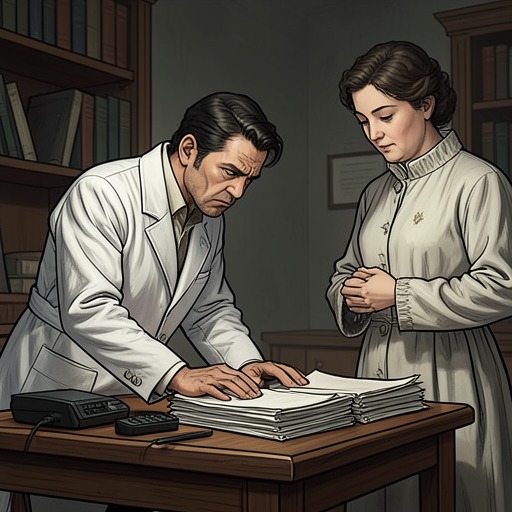
At Somerset Medical Center, Amy encounters a new insulin procedure called an insulin adjustment form. Previously, insulin had been kept in a small refrigerator; now nurses were expected to enter an electronic signature for their estimate of how much remained in a vial. Amy considered that estimate unreliable and objected to being held accountable for what she regarded as guesswork. She asked why insulin was being treated like a narcotic and what made it so dangerous. Her manager, Val, offered no explanation that satisfied her and ordered her to sign. Amy refused.
The form’s importance to Amy was not simply procedural. She suspected that something had happened on her unit, possibly to a patient, but those above her would not tell her what. Her refusal made her conspicuous: the resistance was discussed beyond the ICU, even in Oncology. When rumors later connected an insulin-related death with Charles Cullen, nurses remembered Amy’s objection and her friendship with him. Some avoided her; she feared that the investigation might implicate her personally. The new safeguards had been a sign that insulin was being treated as a serious danger, but the silence around their purpose left Amy to imagine what had occurred and whether she herself had missed something.
Evidence turns friendship into a test
The conflict sharpened when Danny Baldwin showed Amy a Pyxis printout from the night Reverend Florian Gall died. Amy recognized Charles Cullen’s activity on the page. She had often defended him against what she saw as unfair accusations; now the record made it possible for her to imagine that he had done something terrible during those shifts. Yet the document did not immediately reconcile the suspected act with the friend she believed she knew. At home, she read the drug orders and considered what had happened to Reverend Gall, caught between the evidence and her attachment to Cullen.
Cooperation with the detectives therefore became a test of trust as well as a professional risk. Amy wondered whether the investigators might be wrong or manipulating her, and whether she should stand by her friend. She also feared risking her job by lying to Cullen and her employer. She eventually helped the investigation, bringing paperwork to Tim Braun and Danny Baldwin and identifying Cerner patient records they would need in full. She felt exposed and alone, even as their late-night work and shared coffee made her braver. The book does not equate Amy’s actions with Cullen’s; rather, her dilemma shows how responsibility can require acting under uncertainty, when protecting a friend, protecting patients, and protecting one’s own position pull in different directions.
The kidney and the accusation
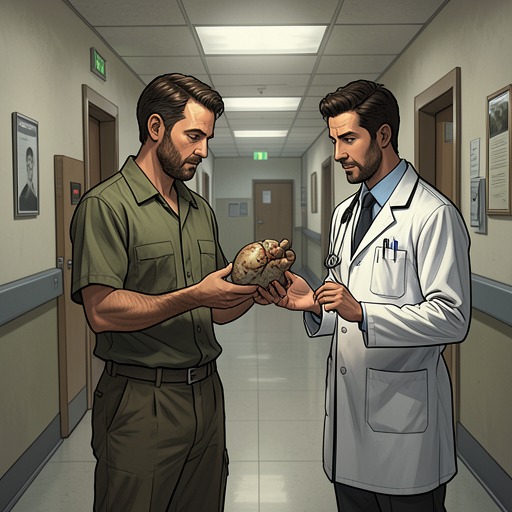
The phrase Playing God becomes explicit when Cullen asks to donate a kidney to Ernie Peckham. Ernie’s family had found no medically eligible relative to donate. His mother, Pat Peckham, had mortgaged her house for his medical bills and placed a public appeal in a local paper, but no donor came forward. A letter reached Cullen in the Somerset County Jail. He was a tissue match, and he understood that a living donation could extend the kidney’s life by six years compared with a cadaver donation.
The proposal reopened public attention to a man whom prison had seemed to neutralize. For victims’ families, the nurse who had taken lives now appeared to be claiming the power to save one. The book leaves Cullen’s private motive unresolved: compassion, a desire for redemption, a need to be helpful, or an attempt to manage his public image cannot be established from the available evidence. Cullen himself knew that the donation would attract publicity and affect his family as well as the recipient. Reverend Kathleen Roney, his chaplain, resisted reducing him to the label Angel of Death, while acknowledging the scale of his crimes and the victims’ families’ claims on him.
Cullen rejected the accusation that donating meant playing God. He distinguished the act of giving up an organ from control over the recipient’s later life, which he placed in God’s hands. He also contrasted the donation with his nursing work: patients had seen him directly take life, he said, whereas he could not promise to give or extend life. The distinction did not erase the harm he had done, nor did it settle how the families should interpret his gesture. It framed the central disagreement: whether an act that may help someone can be separated from the donor’s past and from the power that the act seems to claim.
Delay and unresolved meaning
The donation stalled despite a judge’s signed order. Johnnie Mask worked on the paperwork, and Reverend Kathleen Roney acted as a liaison between the recipient’s family and the hospital. Cullen argued that the state’s concern—that he might harm another patient in a hospital—made little sense when he would be shackled to a bed and guarded. He saw the delay as another obstacle to a positive act; the families could see his continued prominence as an extension of the same will they feared.
As Cullen waited in the New Jersey State Prison, the recipient’s condition worsened. Cullen said Ernie was back in hospital and experiencing roughly one complication a month. He became increasingly depressed, questioning whether the match had any meaning if the donation never happened. He acknowledged that he could not undo the harm he had caused, but asked why he could not do something good. The book leaves that question open rather than allowing the donation to serve as simple redemption or simple manipulation. Playing God thus remains a contested accusation: it describes the fear that Cullen is again exercising power over life, while his defense turns on the limits of what any donor, however compromised, can control.